Catching Atoms in Motion: First Beamtime Experience at ALBA Synchrotron
As a PhD student researching sodium-ion batteries, I’ve always been curious about how sodium ions move through the material during charging and discharging. This movement is key to understanding how the battery works. While I’ve been able to study this at a small scale in the lab, I wanted to see it on a larger, more powerful platform. This is when I decided to apply for beamtime at the ALBA Synchrotron, a large particle accelerator that could give me a better view of what’s happening inside my material. To my excitement, my application was accepted!
The Journey Begins
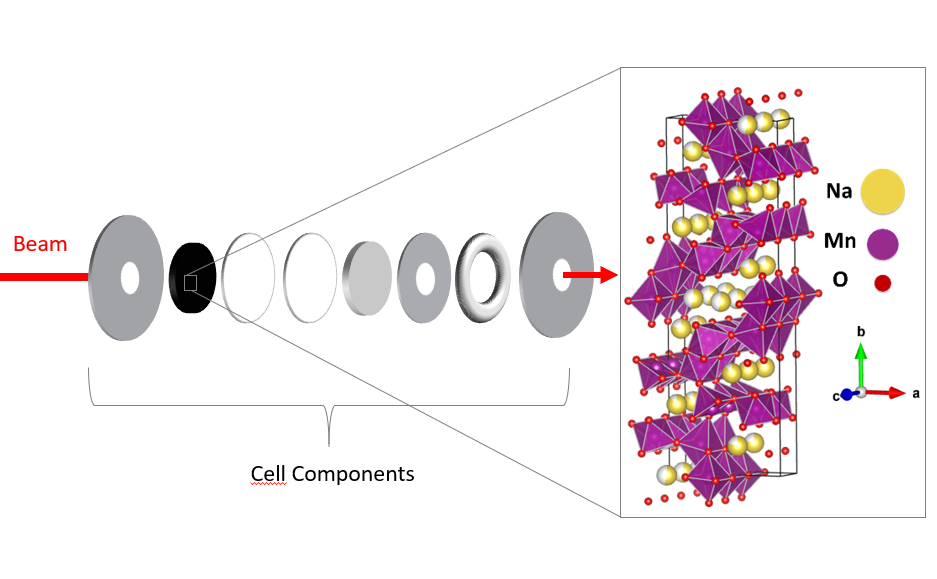
In early July 2025, I boarded a train to Barcelona to begin my experiment at ALBA. I was about to observe my material, Na₄Mn₉O₁₈, in real time as it cycled through its charge and discharge process. My experiment plan was simple but ambitious: cycle the battery cells at different speeds while capturing an X-ray snapshot every few minutes. I worked with beamline scientist Dr. François Fauth who helped me set up the experiment properly.
The Experiment Goes Smoothly
The experiment itself went off without a hitch. The beam was powerful and stable, the detector was fast, and each X-ray snapshot was captured in a matter of a few minutes. As the battery cells cycled, I could see the diffraction patterns on the screen. The movement of the peaks told me everything I needed to know: the sodium ion tunnels in the material were either expanding or contracting.
What surprised me most was how smoothly everything went. As this was my first experience at the synchrotron, I expected some problems, but there were none. I didn’t even have to pull night shifts! I set an alarm every four hours and did a quick check to ensure everything was running smoothly. It felt great to see everything working perfectly.
A Moment to Reflect
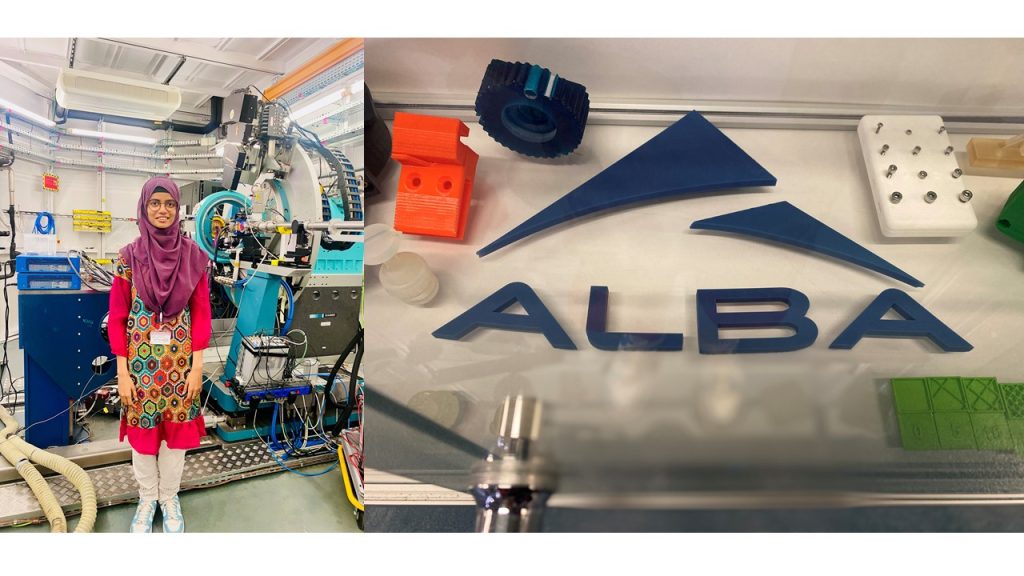
On the final day of my beamtime, I took a moment to reflect on the experience. I wanted to capture the memory with a photo, so Dr. Fauth kindly paused the experiment and stopped the beam for a moment to allow me to take a picture inside the hutch. This small gesture meant a lot, as it marked the end of an exciting and successful week.
After the experiment, I left ALBA with hundreds of diffraction patterns. Now, the real work would begin back in my office: analysing the data. The goal is to turn these patterns into graphs that can help us understand how the sodium-ion tunnels in the material change during cycling.
Looking Back
Reflecting on the experience, my time at ALBA was a major highlight of my PhD. It gave me the chance to visit and perform my experiments in a large-scale facility and observe my material in ways I couldn’t have in a regular lab. The data I collected will be crucial for the next steps in my research. Although the process in the office may not be as glamorous as working at the synchrotron, analysing the data is just as important. It will help us better understand sodium-ion batteries and how to improve them.
Thanks and Acknowledgments
I’d like to thank the Australia-France Network of Doctoral Excellence (AUFRANDE) for supporting my research. A big thank you to my supervisor, Dr. Marie Guignard, for her guidance and support throughout the process. I also want to express my gratitude to Dr. François Fauth for his assistance during the experiment. His expertise made everything run smoothly, and I couldn’t have done it without him.
Key Takeaways:
• Real-time data collection: The synchrotron allowed me to capture X-ray images of sodium-ion behaviour during battery cycling in real time, offering a new way to study material changes that wouldn’t be possible with regular lab equipment.
•Teamwork is essential: Working closely with experienced beamline scientists like Dr. François Fauth was key to the success of my experiment. It showed me the importance of collaboration in research.
• Data analysis matters: While the synchrotron experience was exciting, the real value will come from analysing the data. This will help us understand how to improve sodium-ion batteries and make them last longer.
Find out more about my research project here.
Categories
Latest posts
A PhD journey is not just about a certificate

Why I want to be a scientist (and why I chase light for a living)
From plants to antimicrobial materials: when nature gives you a starting point