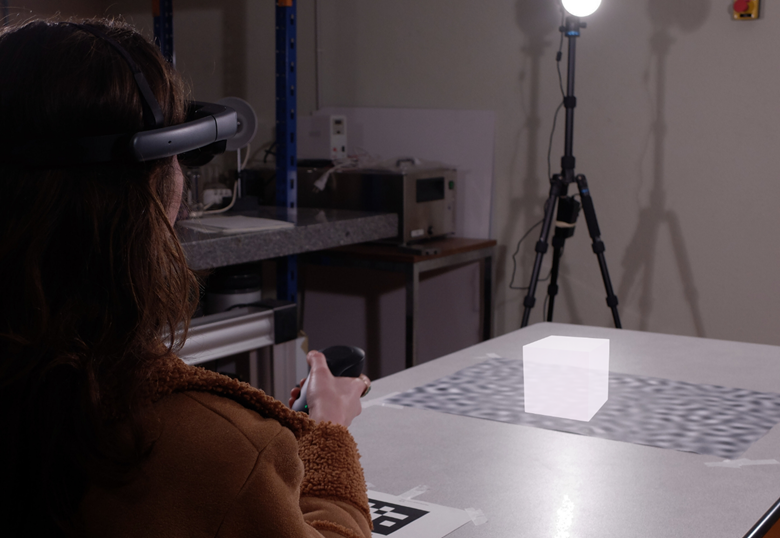
Reinventing the fire: the challenges of nuclear fusion research
Key takeaways:
- Fusion energy mimics the Sun to provide sustainable power.
- Fusion requires achieving a specific “triple product” of plasma density, temperature and confinement time.
- Progress depends on combining many fields of physics and engineering to close the gap between theoretical simulations and experimental reality.
The Motivation of Science
Anyone would agree that light is among the primary things that make our lives possible. After all, it is very challenging to interact with the world without being able to see it. This essential necessity, along with the need for food and heat, has driven people to make one of their first physical inventions: the ability to ignite a flame to bring light and heat where it’s not naturally available.
As the quality of life grew, so did the complexity of technological challenges needed to make the next step to further improvement. People have learned to use light for all sorts of things: communicating signals, first with signal fires and lighthouses, then through optical fibres; magnifying images with microscopes and telescopes; converting the sunlight to electricity; studying the chemical composition of things with spectroscopy… The list of light applications is too long to even attempt naming them all. But one of them returns us to the problem of ignition, which we thought was solved for thousands of years!
The Source of the Sun’s Power
When we look at the Sun (hopefully not with the naked eye), it is natural to ask a question: what is the source of that tremendous power that we can feel millions of kilometres away? It turns out that the answer is: thermonuclear fusion! The Sun is so heavy that its gravity makes the atoms inside it overcome their electric repulsion and combine, producing heavier atoms and huge amounts of energy as a byproduct. Wouldn’t it be cool to try something similar here on Earth? This would have the potential to solve humanity’s need for clean and accessible energy.
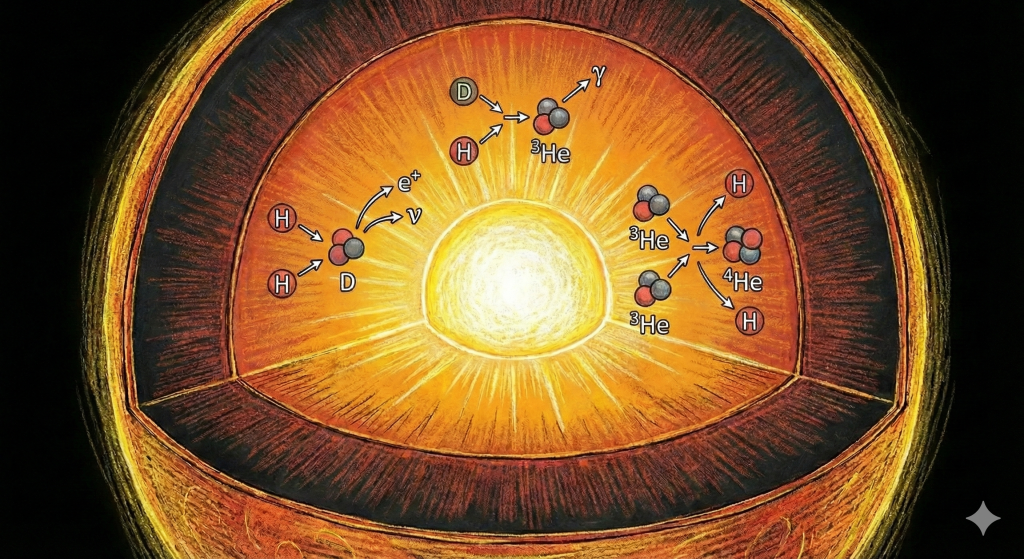
So, this became one of the hot topics in physics in the 20th century. We cannot produce such a gravitational force here (and we wouldn’t want to). But we can try to push the atoms together differently…
The Recipe for Fusion
In fusion, we are talking about temperatures of around 100 million degrees. This is so much that atoms lose their electrons, producing a state of matter we call plasma – a soup of separate electrons and ions. The necessary condition to drive the fusion process is often expressed through the so‑called triple product: a combination of three plasma characteristics. To produce more energy than it loses, the plasma has to be:
- Dense enough
- Hot enough
- Remain in those conditions long enough
Increasing the parameters even further will eventually lead to ignition: a point where the energy output is sufficient to sustain the reaction until it runs out of fuel. Just like a burning fire that produces more energy than a spark that ignited it.
Generally, we are good enough at heating things. The challenge is instead in holding the plasma together, or confining it. One of the ways the scientists have been studying is called magnetic confinement fusion: you first heat the plasma, then apply carefully designed magnetic fields to confine the particles in a narrow region of space for a long period of time, allowing them to collide and fuse. Using the controllable magnetic fields can let us reach high confinement times, but plasma density will have to stay low enough. Otherwise, the plasma becomes too unstable, and the reaction stops.
Lasers: The Inertial Approach
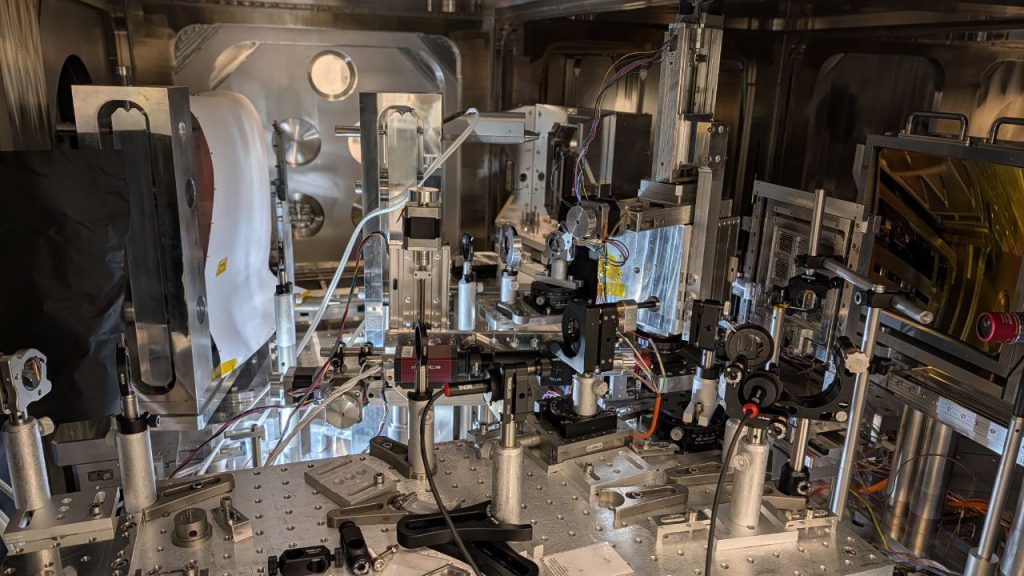
But there is a different way: one that returns us to the applications of light. Light doesn’t have to be uniform and intangible like we are used to seeing it. It is possible to make the light particles move coherently in a very narrow beam, which is exactly the kind of light the lasers produce.
Even a regular laser pointer can produce temporary damage to a human eye. But the most advanced lasers of today are 1,000,000,000,000,000,000 times more powerful. At such a scale, the light can heat things to temperatures thousands of times higher than in the Sun’s core. But, more importantly, that light also produces enormous levels of pressure.
If focused on a fusion fuel pellet, generally a few millimetres in size, a laser beam can turn its outer layer into plasma. This energy is transferred to the fuel so quickly that it launches a shockwave, compressing it to extreme densities comparable to stellar interiors and even beyond. The approach is called Inertial Confinement Fusion, since the fuel is held together by the inertia of its moving shell. This only works until the shock reaches the center of the pellet, which takes only a few nanoseconds. But because of the density levels, this is still enough to produce an energy gain. So we approach the triple product from the density side, contrary to the magnetic confinement schemes, where the advantage is a much longer confinement time.
Challenges and Future
In reality, many little details delay the progress, be it the state of the existing laser technologies, blanks in the understanding of matter behaviour at such extreme conditions, target design, plasma instabilities or much more. This is why it is so important to have physicists and engineers from many different fields work together, approaching the challenge from all sides.
In CELIA, together with many other laboratories from different countries, we design, perform and analyse experiments, attempting to cover the blanks in fusion science. My personal work is very diverse: assembling the optical systems inside an experimental chamber, gluing targets thinner than a human hair, measuring chamber radiation after the laser shots, running complex computer simulations in an attempt to explain the experimental results or come up with a new design… Often, I have to write my own programs to extract data from different kinds of diagnostics or tie my simulation outcomes with real-world results. This is why I never get bored.
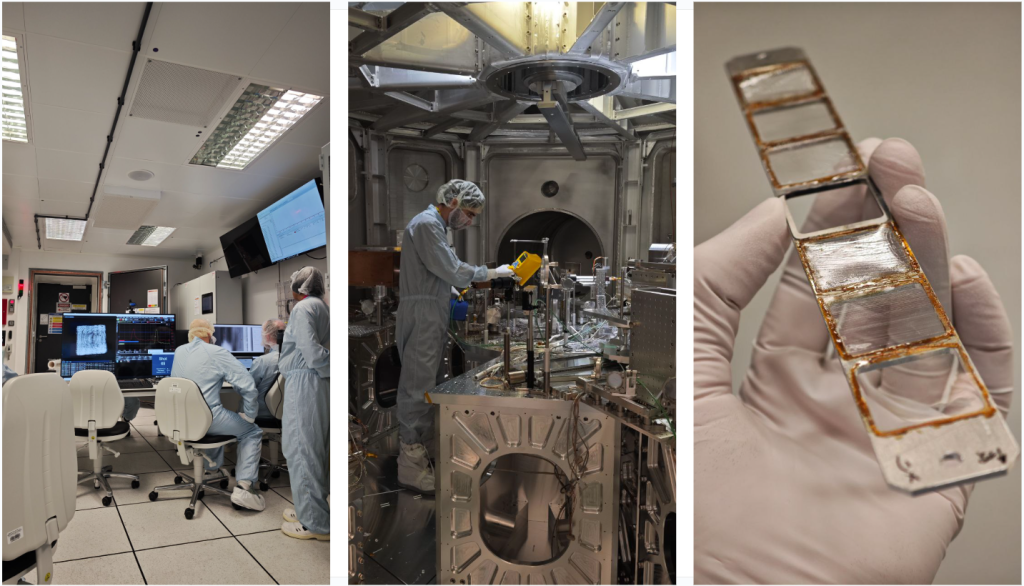
Center: Me, assessing radiation safety after a laser shot.
Right: Samples mounted on a holder.
There has been a lot of progress in the past few years, confirming that the theoretical predictions about fusion are really achievable. And just like the first human-made fire that solved the very basic need for light and warmth, we focus on the same things, although formulated in smarter words: clean, sustainable and affordable energy to provide even easier access to all of the essential things, with added benefits of lower health and environmental impact and extreme safety.
More information about my research topic is available here: Anton Moroz – Aufrande