The Hidden Green Along Our Roads—and Why It Matters
When you drive along a road, you probably don’t think much about the grass on the side. It’s just there—cut regularly, quiet, almost invisible. But what if those green strips could help protect biodiversity, reduce carbon emissions, improve road safety, and even save public money?
These areas, known as roadside verges, are far more important than they seem.
With an estimated 25 million kilometres of new roads expected worldwide by 2050, these spaces are becoming one of the largest managed green networks on the planet. In countries like France, which has one of the densest road infrastructures in Europe, roadside verges form a continuous interface between human activity and natural ecosystems.
Managed well, they can act as ecological corridors, support biodiversity, improve water and soil quality, and even help prevent risks such as fires or flooding. Managed poorly, they can become costly, inefficient, and environmentally harmful.
So the question is simple: how can we manage them better?
A complex problem hiding in plain sight
Maintaining roadside verges is not as simple as sending a mowing machine along a road.
Local and regional agencies must plan detailed operations every year. They decide when and where to mow, how to allocate machines and staff, and how to cover large networks within limited time and budget constraints. At the same time, they must ensure road safety, respect environmental regulations, and increasingly, consider sustainability goals.
In practice, these decisions are often made under pressure, with limited tools and fragmented information. Even more challenging, there is still a gap between academic research and real-world operations. Many advanced solutions exist in theory, but they are rarely implemented in practice.
Sustainability adds another layer of complexity. While there is growing interest in reducing environmental impact, sustainable practices—such as collecting and reusing the cut biomass—are often seen as too expensive or too difficult to organise.
As a result, many decisions focus only on short-term efficiency, rather than long-term impact.
Why I chose this topic
I did not start my PhD with a passion for roadside management specifically.
My background is in industrial engineering, and during my undergraduate studies, I became increasingly interested in solving real-world problems using mathematical models. I was particularly drawn to operations research—the field that focuses on improving decision-making through modelling and optimisation.
What attracted me most was not just the technical challenge, but the possibility of creating solutions that go beyond theory and can be applied in real organisations.
Vehicle routing problems, for example, are known to be among the most complex optimisation challenges. They involve deciding how to move vehicles efficiently through a network while respecting many constraints. I saw this as an opportunity to push my skills further while working on something that could have a tangible impact.
Roadside management turned out to be the perfect application: a real-world problem, technically challenging, and closely linked to sustainability.
Turning complexity into better decisions
This is where my research comes in.
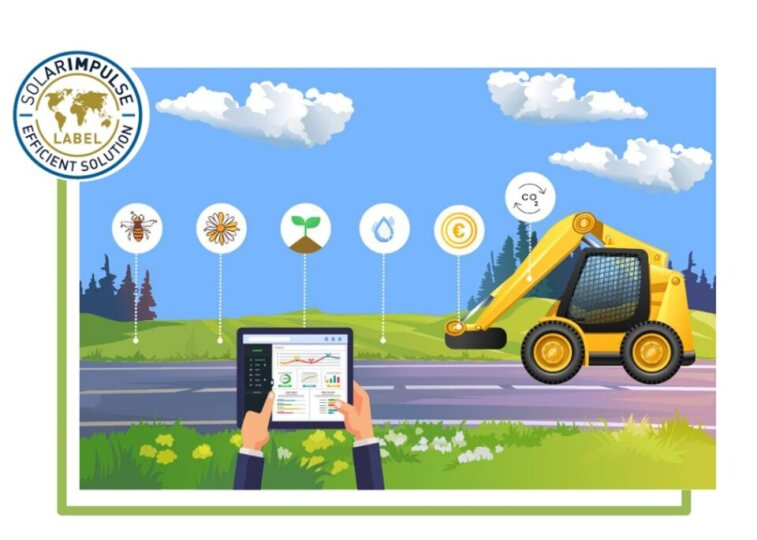
I am developing a decision-support tool to help plan roadside maintenance operations in a more efficient and sustainable way. The core idea is to simulate and compare different strategies before they are implemented in the real world.
To do this, I use computational optimisation models written in Python, combined with specially designed algorithms capable of solving large and complex routing problems. One of the main challenges is that these problems are extremely difficult to solve within a reasonable time, so part of my research focuses on developing methods that can find high-quality solutions efficiently.
Rather than optimising a single objective, such as cost or distance, the model considers multiple dimensions at the same time. It can evaluate trade-offs between economic costs, environmental impact, and social benefits.
For example, it can explore scenarios where mowing operations are slightly more expensive but significantly reduce carbon emissions by collecting biomass for energy production. It can also assess how different planning strategies affect safety, time constraints, or resource allocation.
The goal is not to provide a single “perfect” solution, but a set of possible scenarios. This allows decision-makers to choose the option that best fits their priorities and constraints.
From waste to resource
One of the most interesting aspects of roadside management is the potential to transform what is currently treated as waste into something valuable.
Every year, large amounts of grass are cut along roads and often left on site or discarded. However, this biomass can be collected and used in processes such as methanisation to produce energy.
The challenge is that organising this collection requires additional planning, coordination, and cost. Without proper tools, it is difficult to know whether it is worth it.
By integrating this dimension into the optimisation model, my research helps evaluate when and where biomass collection becomes beneficial—both economically and environmentally.
Why this matters to everyone
At first glance, roadside management may seem like a technical or niche topic. But its impact is surprisingly broad.
Better planning means safer roads, as maintenance can be scheduled more effectively and visibility improved for drivers. It also means a more efficient use of public budgets, which are often limited and under pressure.
From an environmental perspective, improved management can support biodiversity, reduce emissions, and contribute to more sustainable infrastructure systems.
In other words, this is about making everyday systems—like the roads we use all the time—work better for both people and the planet.
Looking ahead
One of the most encouraging aspects of my research is the opportunity to collaborate with real organisations. By working with agencies responsible for roadside maintenance in France, I can test ideas, share results, and ensure that the solutions developed are relevant and applicable.
This connection between research and practice is essential.
Because in the end, the goal is not just to build models or write code—it is to support better decisions, with real impact on territories and communities.
So next time you are on a road trip, take a moment to look outside.
That strip of grass you see is not just a detail of the landscape. It is part of a much larger system—one that, with the right decisions, can become safer, more efficient, and more sustainable.
Learn more about my project here: DC-22 – AUFRANDE