Grappling with Uncertainty: Lessons from Climate Science and My Antarctic Research Journey
Understanding the Many Faces of Uncertainty
In climate science, the word “uncertainty” connotes way more than a technical term – it’s a fundamental property of the system we study. Every dataset, model output or forecast carries with it some degree of doubt: about how the atmosphere or ocean was observed, how well models represent physical processes, or how random natural variability manifests.
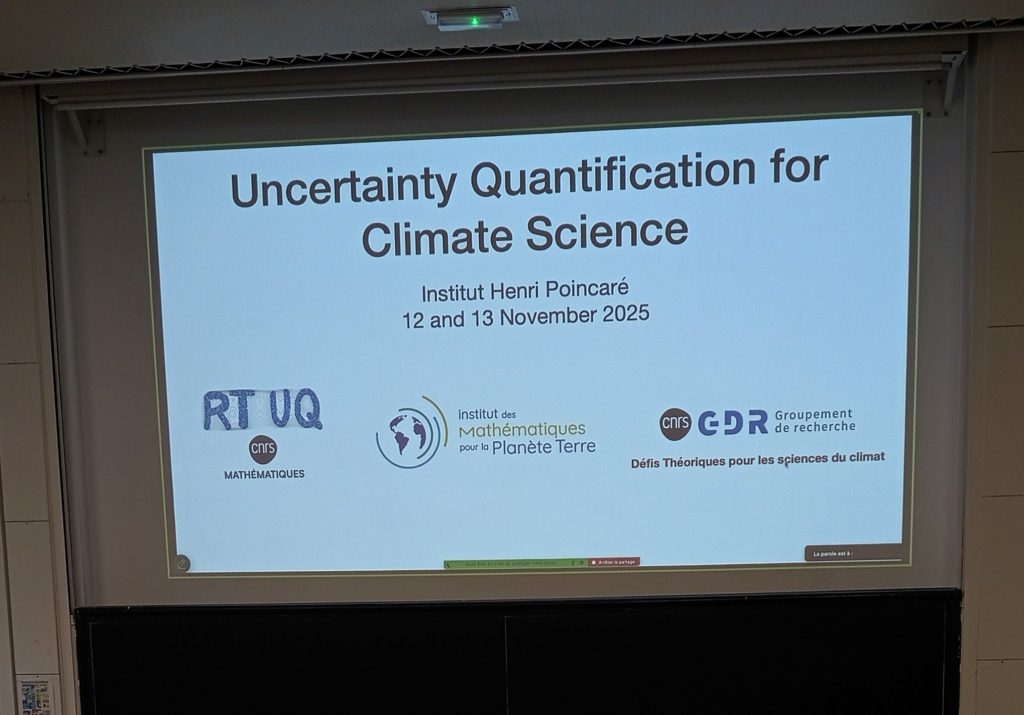
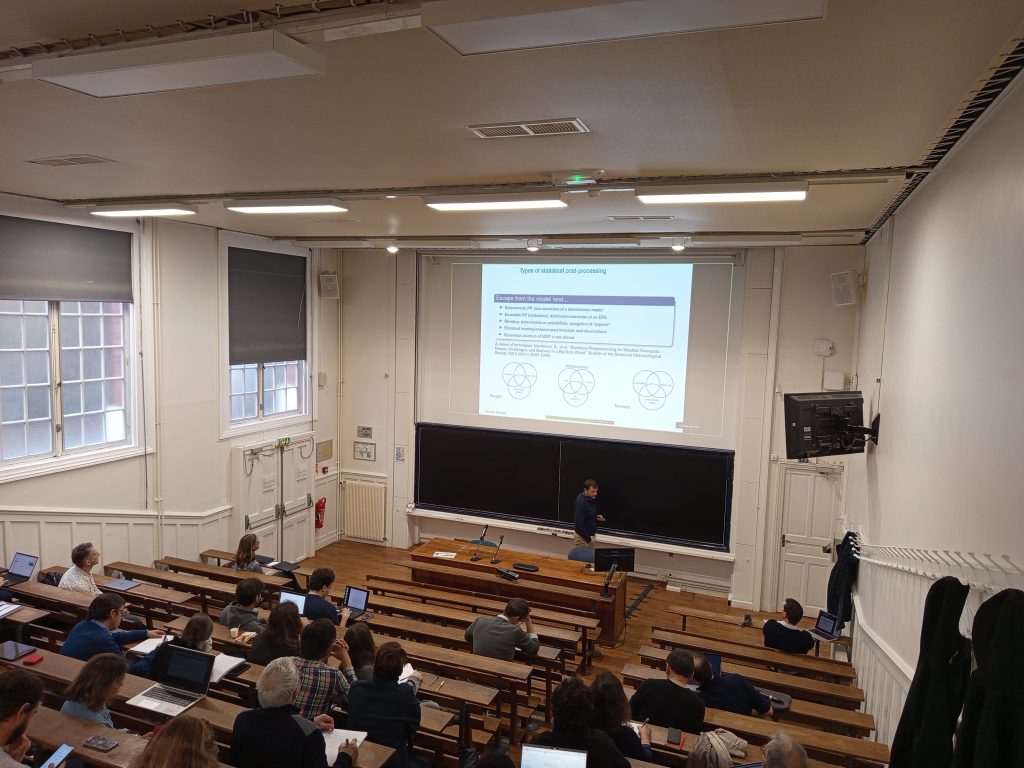
I was reminded of this during the Workshop on Uncertainty Quantification for Climate Science at the Institut Henri Poincaré (IHP) in Paris. Over two days of talks and discussions, scientists explored how uncertainty arises, how it can be quantified, and how we can use it to improve our understanding of Earth’s climate rather than fear it.
Quantifying the Unknown
One of the key lessons I took away was that quantifying uncertainty is as important as reducing it. Without knowing how uncertain a result is, we can neither interpret it correctly nor trust it in decision-making. Climate scientists use several approaches to quantify uncertainty:
- Data Assimilation, where observations are blended with model forecasts, balancing how much we trust each source using error covariances (often labelled Q for model uncertainty and R for observation uncertainty).
- Ensemble Forecasting, where the same model is run many times with slightly different initial conditions or parameters. The spread among the ensemble members tells us how sensitive the system is, and gives a statistical picture of uncertainty.
- Statistical Post-Processing, which corrects systematic biases and misrepresented spreads in model ensembles to make them more realistic.
- And increasingly, Machine-Learning Surrogate Models, which approximate complex models and can learn to represent their uncertainty efficiently, helping researchers run thousands of simulations in a fraction of the time.
Together, these tools turn uncertainty from a source of frustration into something to measure, communicate, and learn from, like a quantitative companion.
Why Uncertainty Is Especially Challenging in Climate Research
Even with powerful models and satellite data, the climate system remains inherently unpredictable beyond certain timescales. The main challenge lies in understanding which uncertainties matter most. In some cases, the problem comes from the structure of the model, that is the equations or approximations used. In others, it results from data scarcity, especially in regions like the polar areas or over the oceans, where direct observations are limited. Internal climate variability, model parameter choices, and even the way we describe physical processes like cloud formation or sea-ice melt all introduce their own shades of uncertainty.
But perhaps the biggest challenge is interpreting uncertainty correctly: knowing when a model is confidently wrong or cautiously right.
Bringing These Lessons to My Research
My own work under the AUFRANDE Doctoral Program focuses on ‘Climate extremes in Antarctica’, especially dry and cold spells. The former are periods of unusually low precipitation that can potentially influence the continent’s surface mass balance and local atmospheric circulation.
The Antarctic environment is one of the most data-sparse regions on Earth; especially observed precipitation data which is essentially non-existent. Direct measurements are few, and most of our understanding comes from regional climate models such as the Modèle Atmosphérique Régional (MAR). MAR provides valuable high-resolution information, but like any model, it carries its own uncertainties, stemming from its parameterisations, input data and physical assumptions.
After the IHP workshop, I’ve become more conscious of how important it is to trace and understand these uncertainties. In the coming months, I’ll be delving deeper into how MAR’s uncertainties were quantified. It’ll be interesting to know how the developers calibrated the model against observations, how ensemble or error estimates were generated, and what these mean for interpreting my results on Antarctic dry and cold periods.
Recognising the model’s uncertainty will allow me to give my analyses clearer context: distinguishing between real climatic signals and model artefacts, and ensuring that the ‘dryness’ I detect isn’t simply a product of model limitations.
Embracing Uncertainty as Insight

Uncertainty is often perceived as weakness in science, but in climate research, it is a form of honesty. It reminds us that our models are approximations of a wonderfully complex and dynamic Earth system which means that improving them is an ongoing process of refinement, not finality.
For me, understanding and communicating uncertainty is a scientific responsibility. It isn’t just a technical task. Whether studying the variability of Antarctic precipitation or the reliability of global reanalyses, being aware of uncertainty means being aware of what we truly know, and what we don’t yet know.
In the frozen silence of Antarctica, uncertainty speaks loudly. My job as a climate scientist is to listen carefully and quantify it.