Stepping Into the Research World: Growing Through Three Conferences
This post reflects on my conference experiences in marine economics research and how attending IIFET, EAFE and ICES ASC helped shape my academic confidence, research direction and identity as an early-career researcher.
I attended my very first conference before officially starting my PhD journey. At that time, I had almost no idea how academic conferences worked. I didn’t know how to plan a suitable schedule, how to choose which parallel sessions to attend or how to introduce myself to people in the same field. Over the first year of my PhD, I participated in another two conference experiences in marine economics research. Together, these conferences helped me move from simply observing and exploring to immersing myself and contributing.
In this post, I would like to share how these three experiences helped me step into the research world and slowly build confidence as an early-career researcher attending conferences.
1. IIFET 2024 – Penang, Malaysia
My first conference was The International Institute of Fisheries Economics & Trade (IIFET) 2024 in Penang, Malaysia. IIFET was the starting point of my conference experiences in marine economics research, giving me an initial understanding of how researchers communicate and connect. It was my first exposure to a global research community — diverse backgrounds, different perspectives and many new ideas.
At that time, I had just received my PhD offer. I was still trying to understand what my research would be. I attended without a presentation or poster; my goal was simply to observe how research is shared and discussed. I wanted to see how other PhD students think, present and structure their questions.
However, because my background was mainly economics and my PhD topic is interdisciplinary, many presentations were difficult for me to fully understand. I couldn’t yet engage in deep discussions. But although I did not bring home a lot of academic knowledge, I gained something foundational:
- How researchers introduce and position their work
- How they communicate novel ideas
- How networking and collaboration start in real life
IIFET gave me the first map of the field. I left with curiosity and motivation for what would come next.
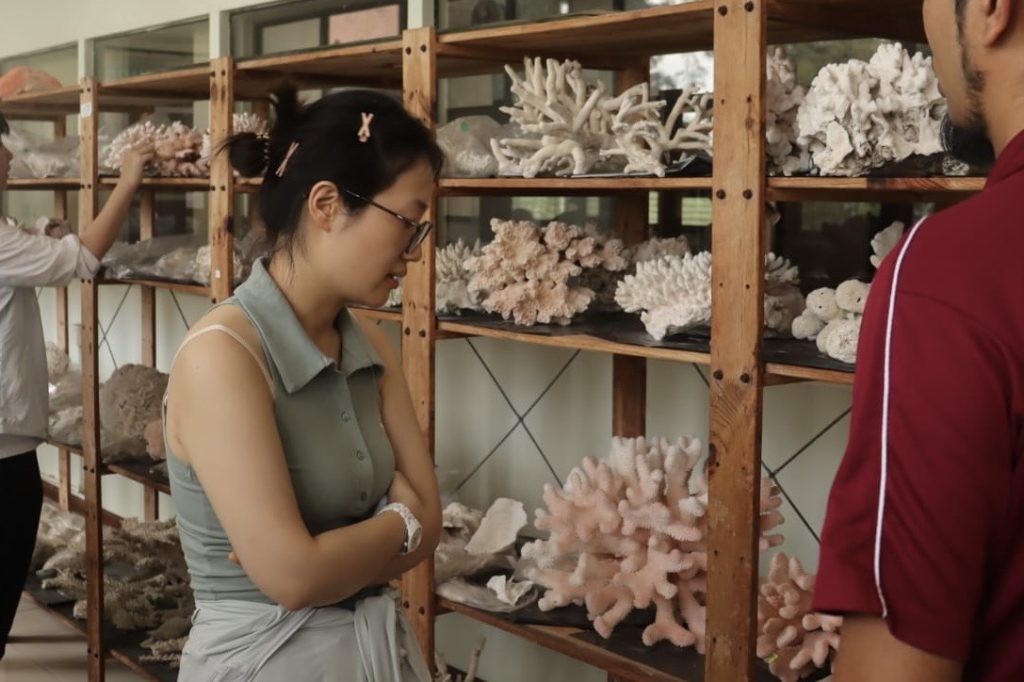
Taken when visiting CEMACS Universiti Sains Malaysia in July 2024.
2. EAFE 2025 – Rome, Italy
The second conference was the European Association of Fisheries Economists (EAFE) 2025 in Rome. Compared to IIFET, EAFE is smaller and more Europe-focused, and the participants often already know each other. The environment felt more like a professional research community — people sharing common disciplinary language and a long-term conversation.
This time, I was not just observing. I presented the initial results of my literature review and early ideas for my socio-economic conceptual model. By then, I had already been working deeply on my research, reading more widely and gaining stronger understanding of the socio-ecological system I study. I could follow other presentations more easily and identify methods and arguments that could inspire my own work.
After my presentation, several researchers approached me with positive feedback and interest in my focus on the cumulative impacts of offshore wind farms on fisheries. This was the first time I felt that my research direction was not only personally meaningful but also recognized and relevant in the field.
After EAFE, I felt like I had taken my seat at the “round table” of the European marine and fisheries research community — I was no longer just listening; I was part of the conversation.
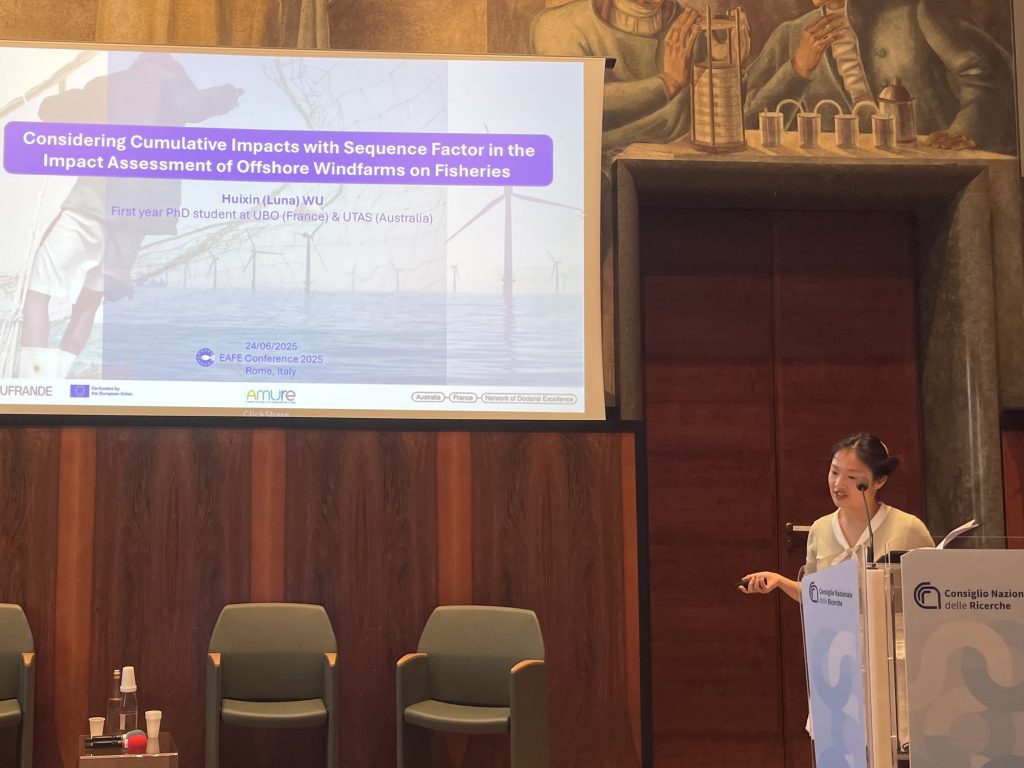
Taken during my presentation at the EAFE Conference, July 2025.
3. ICES ASC 2025 – Klaipeda, Lithuania
The third conference was the International Council for the Exploration of the Sea Annual Science Conference (ICES ASC) 2025, one of the largest and most formal marine science conferences. ICES focuses on how science supports policy and management decisions. The participants included scientists, policy advisors, government representatives, NGOs and industry stakeholders.
I presented a refined version of the work I shared at EAFE, with cleaner data and a clearer conceptual framework. I received constructive feedback, including an important reminder: next time, I should bring actual model results, not only conceptual structure. This was realistic and motivating — a sign that I was now expected to contribute substance, not just ideas.
The most impactful moment was when two research groups from the USA approached me after my talk. They told me they were working on similar questions and were interested in future collaboration. We exchanged perspectives, and at that moment, I realised:
I am not working alone. I am part of a larger research effort.
This gave me a new kind of confidence — not loud confidence, but quiet, stable, grounded confidence.
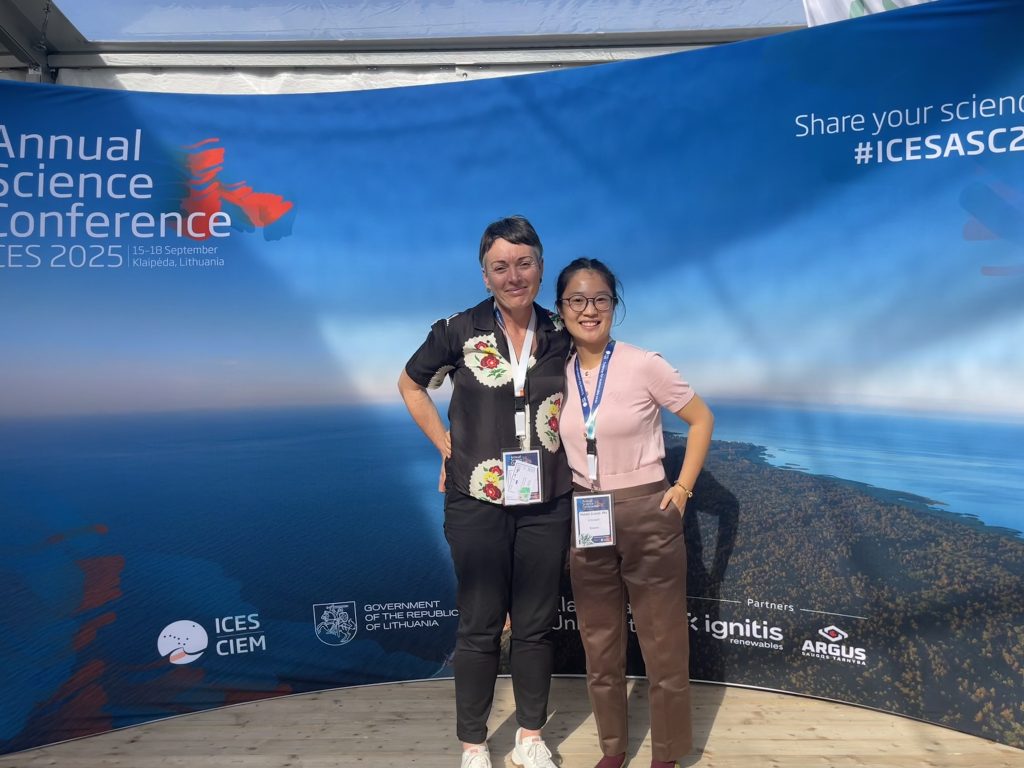
Taken with Australian supervisor Emily Ogier (Univeristy of Tasmania) in September 2025
Looking Back,
these conference experiences in marine economics research helped me move from observing to contributing, and from uncertainty to confidence. Through these 3 conferences, I shifted roles from observer to contributor.
I moved from the outside to the inside.
From curiosity to clarity.
From learning to belonging.
These experiences shaped not only my research direction but also my identity as a researcher. I now know how to prepare presentations, how to choose parallel sessions strategically, how to approach others and start discussions and how to recognise the value of my own work — even when it is still in progress.
I still have a long journey ahead, but now I feel much more prepared — not only to present my research, but to grow with it.
If you are interested in knowing more about my research subject, please see my AUFRANDE project.
Categories
Latest posts
Reinventing the fire: the challenges of nuclear fusion research
My first year of the PhD as an AI-assisted condition monitoring researcher
Beyond the Science: What I Learned About Research Emissions at the CBH Summer School