Why I want to be a scientist (and why I chase light for a living)
I was in my fourth year of school when I first decided I wanted to be a magician.
I had just finished reading a short story on Madame Curie, one of those kid-friendly biographies with all the suspenseful and good parts. A picture of a scientist holding a vial of something called radium that glows in the dark. Later, I would find out that the magical potion she discovered would be something that all of humanity would use. Two Nobel Prizes, which surely every magician gets after the 12th year of school… For that kid, Marie Curie was not a scientist – she was a magician in a lab coat.

Naturally, I told my parents and friends that I wanted to be a magician and win more Nobel Prizes than Madame Curie. I just didn’t know that I would end up chasing light instead of magic tricks.
From magic to physics
The wonderful but slightly cruel thing about growing up is that your understanding of the world gets better. I found out that we don’t get a Nobel Prize when we complete high school (what a bummer!). My role model was not a magician, but a scientist. Along the way magic became more interesting as I understood how it worked. The tricks weren’t tricks at all, they were physics, mathematics, chemistry, biology. You know how they work and you can understand why.
That’s the thing that still fascinates me after all these years. A magician wants you to believe something impossible happened. A scientist wants to show you that something wonderous happened and can give you the tools to understand the what-why-how. I was not a fan of tricks anymore. I wanted to take it apart, explain and build something new.
Why light and what is a frequency comb?
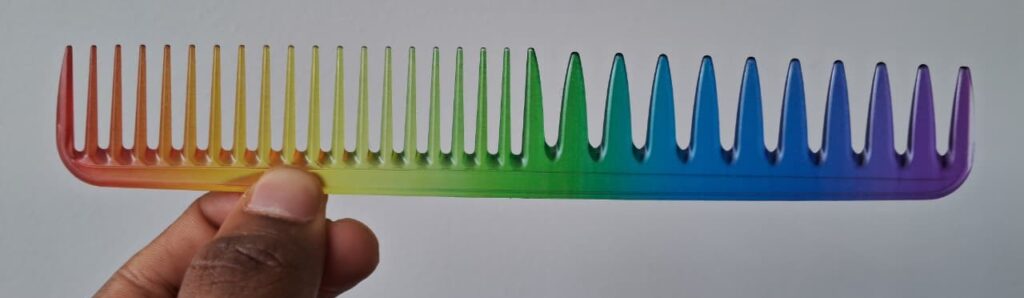
Which brings me to my research: I work on optical frequency combs – not exactly a hair comb as shown in the picture above. It is a special kind of ultrafast laser source whose spectrum is not a smooth blur of colours. Instead, it has comb-like evenly spaced spectral lines. Imagine a rainbow made of a thousand equidistant threads, each one locked to its neighbours with extraordinary precision. That precision is what makes frequency combs so powerful. They can be used to measure time more accurately, transfer a tremendous amount of data in optical communications or search exoplanets. The following figure describes my research more appropriately.
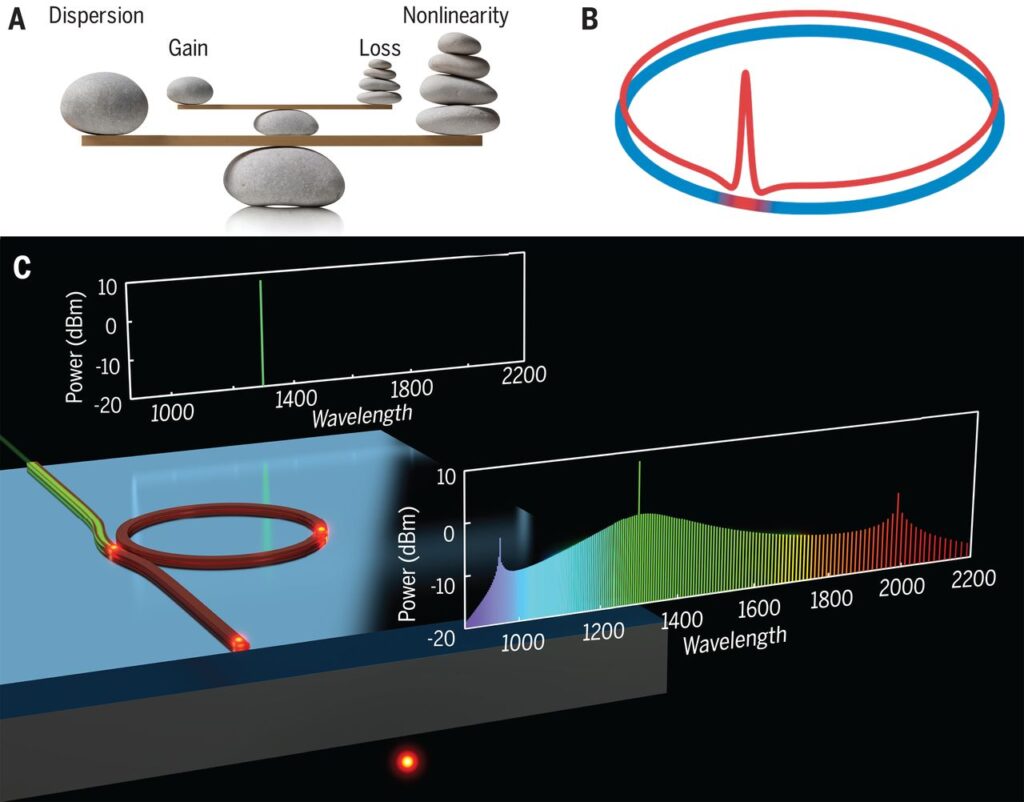
Honestly, what motivated me to work on this specific topic was not just application. It was that frequency combs let me be three kinds of scientists at once. I could not just choose one.
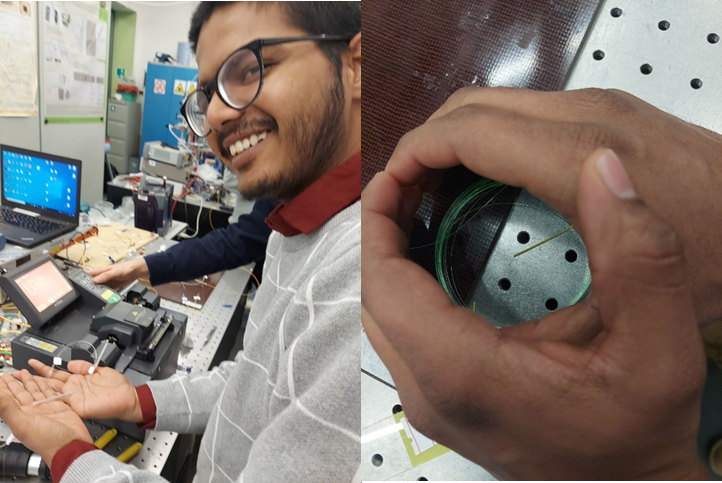
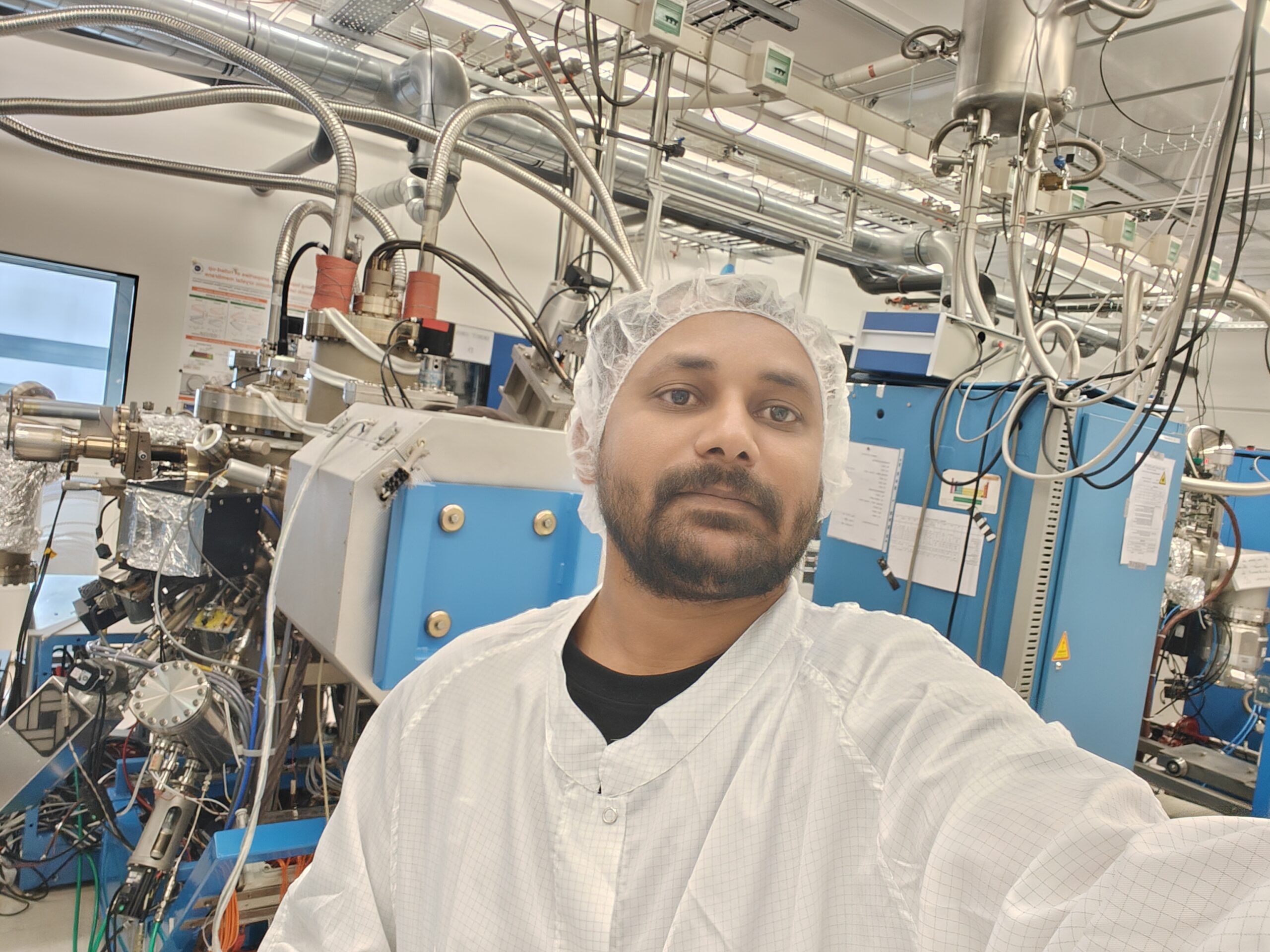
I am an experimentalist. I realised it during one of practical sessions of a Laser Physics course during my masters. There is something deeply satisfying about spending an afternoon in the lab with real equipment, aligning a beam, fiddling around with optical fibres. For proof, I have a picture of me working on a femtosecond fibre ring laser in 2022. You see the equations come alive in your hands. It’s ugly because it’s not exactly as on paper; it requires patience and discipline and I love it.
I get to be an engineer. The core of my research relies on designing photonic integrated circuits – tiny structures of glass where light is squeezed into waveguides a fraction of the width of a human hair. This is where the magic happens: the light gets trapped, it interacts with itself and with the material. Linear and nonlinear optical effects start swinging things around. These chips require you to think of physics, materials and geometry all at the same time. You build a tiny stage where light will perform magic tricks.
And I am somewhat of a theorist. Not everything can be discovered by trial and error. Numerical modelling lets us explore the physics even before I turn on a laser. How? Cheaply, in code. Performing simulations and seeing them come alive in experiments is my definition of doing science.
From time to time, I go back to my eight-year-old self and his idea that scientists are wonderful magicians. It’s just that I understand the tricks now, most of them. The magic is not in the mystery; it’s in the moment of understanding how it happened and realising you can do it as well. Every time I get inside the lab, I go through this joy of building and the curiosity of what will happen. Maybe this is what Madame Curie also felt.
I am not chasing a Nobel Prize anymore. Because along the way, I have discovered something even more wonderful than an award: being a scientist. A long time ago, I was moved by this one sentence from that chapter on Madame Curie: “Science was her life, research was her life’s goal and gaining more and more knowledge was her life’s vow”. I never realised the full meaning of it back then. But I do now.
Find out more about my research project here.
Categories
Latest posts

Why I want to be a scientist (and why I chase light for a living)

From plants to antimicrobial materials: when nature gives you a starting point
Coaxing Hexagonal Silicon-Germanium (SiGe) to emit light for laser action